How Much Do Full Mouth Dental Implants Actually Cost in 2026?
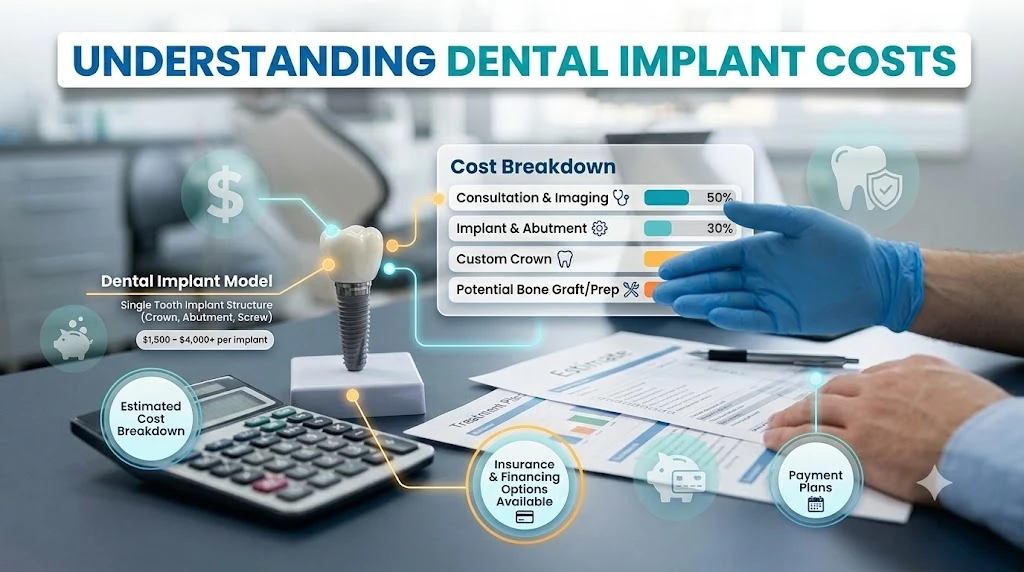
The cost of full mouth dental implants in the United States ranges from $16,000 to $90,000+ for both jaws ($8,000 to $45,000 per arch), with most patients paying between $30,000 and $56,000 total for permanent fixed bridges like All-on-4 or All-on-6.
Choosing removable snap-in implant dentures brings the full-mouth cost down to $16,000 to $27,000, while replacing teeth with 8 to 10+ traditional individual implants and porcelain bridges per jaw can reach $60,000 to $90,000+. Because every person’s jawbone and gum health are unique, your exact price depends on the number of implants placed, whether you choose acrylic or zirconia teeth, and whether you need preparatory care like extractions, bone grafting, sinus lifts, or IV sedation.
Why Dental Implant Prices Confuse You (And What Clinics Hide)
If you have been searching online for the cost of full mouth dental implants—or maybe you just walked out of a dental consultation holding a treatment estimate that looks like the price of a brand-new SUV—take a deep breath. You are not alone.
Over the years, I have sat across the consultation desk from hundreds of patients who felt overwhelmed, self-conscious about failing teeth, and frustrated by wildly different price quotes. You might see a billboard advertising “$12,500 per arch” down the road from a clinic quoting $55,000 for the whole mouth. Why is there such a massive gap?
Here is the honest secret: “full mouth dental implants” is not one single treatment. It is an umbrella phrase covering five very different ways to rebuild your smile. Even more importantly, some offices quote you only for the surgical placement of the metal posts and a temporary plastic set of healing teeth—leaving out the $8,000 to $15,000 lab bill for your final permanent teeth four months later.
Let’s walk through every option in plain, simple English so you know what is fair, what to watch out for, and how to protect your wallet.
2026 Full Mouth Dental Implant Cost Comparison by Treatment Option
In dentistry, your upper jaw is called one arch and your lower jaw is a second arch. Replacing a “full mouth” means restoring both arches. Here is how the five main options compare side by side, grounded in current data from national providers like Aspen Dental, ClearChoice, and surgical centers like Breakwater Oral Surgery:
| Treatment Option | Implants Per Arch | Cost Per Arch (1 Jaw) | Full Mouth Cost (Both Jaws) | Removable by You? | Tooth Material |
|---|---|---|---|---|---|
| Removable Implant-Supported Dentures (Snap-In Overdentures) | 2 to 4 implants | $8,000 – $13,500 | $16,000 – $27,000 | Yes (snaps on and off for nightly cleaning) | Reinforced acrylic denture with nylon snap-in clips |
| All-on-4 Fixed Full-Arch Bridge (Acrylic / Hybrid) | 4 implants (2 straight, 2 tilted) | $14,000 – $24,000 | $28,000 – $48,000 | No (bolted in; only a dentist can remove) | Titanium bar with high-impact acrylic teeth |
| All-on-4 Fixed Full-Arch Bridge (Monolithic Zirconia) | 4 implants (2 straight, 2 tilted) | $20,000 – $32,000 | $40,000 – $64,000 | No (permanently fixed bridge) | Solid custom-milled zirconia ceramic |
| All-on-6 Fixed Full-Arch Bridge (Acrylic or Zirconia) | 6 implants | $22,000 – $36,000 | $44,000 – $72,000 | No (permanently fixed bridge) | Titanium-acrylic hybrid or monolithic zirconia |
| Traditional Full Mouth Implants (Segmented Bridges / Crowns) | 8 to 10+ implants | $30,000 – $45,000+ | $60,000 – $90,000+ | No (cemented or screw-retained porcelain/zirconia bridges) | Custom porcelain or zirconia bridges |
Clear Breakdown of Your 5 Treatment Choices
1. Removable Implant-Supported Dentures (“Snap-In Dentures”)
- Cost: $8,000 to $13,500 per arch ($16,000 to $27,000 full mouth), matching 2026 national averages at Aspen Dental ($8,289/arch average) and ClearChoice ($8,000–$13,500/arch).
- How It Works: Your dentist places 2 to 4 titanium implants into your jawbone. Instead of sliding around on messy denture glue, your custom denture has small nylon clips underneath that snap firmly onto the implants.
- Best For: Patients who want rock-solid stability while eating and talking at roughly half the price of a fixed bridge. You unsnap the teeth at night to brush them, and the upper denture often leaves the roof of your mouth uncovered so you can taste food naturally again.
2. All-on-4 Fixed Full-Arch Dental Implants
- Cost: $14,000 to $32,000 per arch ($28,000 to $64,000 full mouth).
- How It Works: Your surgeon places 4 implants per jaw—two straight posts in the front where bone is thickest, and two tilted posts in the back. As clinical research published in the Journal of Periodontal & Implant Science (NIH/PMC) shows, angling those back implants allows the surgeon to anchor into strong bone while steering clear of sinus cavities and nerve canals, often saving you the cost and healing time of bone grafting.
- Best For: People who want permanent teeth that stay in their mouth 24/7 and have mild-to-moderate bone loss in the back of the jaw.
3. All-on-6 Fixed Full-Arch Dental Implants
- Cost: $22,000 to $36,000 per arch ($44,000 to $72,000 full mouth).
- How It Works: Just like All-on-4, except your bridge is anchored on 6 implants per jaw instead of 4.
- Why those 2 extra implants matter: Think of implants like fence posts holding up a heavy gate. If you only have 4 posts and 1 loosens, the whole bridge usually has to come off while a new implant heals. With 6 posts, chewing force is spread out more gently, and if 1 implant ever fails, the remaining 5 can often keep holding your bridge in place. Surgeons especially love All-on-6 for the upper jaw, where bone is naturally softer.
4. Fixed Bridge Materials: Acrylic Hybrid vs. Solid Zirconia
Why does one fixed arch cost $16,000 while another costs $30,000? Often, it is the material of the visible teeth:
- Acrylic Hybrid (Titanium Bar + Acrylic Teeth): Slightly softer bite feel and cheaper upfront, but acrylic is porous. Over 5 to 10 years, it can absorb coffee or wine stains, and the teeth can chip or wear down if you grind your teeth.
- Monolithic Zirconia: Carved by computer out of a solid block of biocompatible ceramic. As the U.S. Food and Drug Administration (FDA) notes, titanium and zirconium oxide are the most thoroughly tested, safe implant materials available. Zirconia will not absorb odors or stains and resists cracking, though it costs $4,000 to $8,000 more per arch to craft.
5. Traditional Full Mouth Dental Implants (Individual Implants & Segmented Bridges)
- Cost: $30,000 to $45,000+ per arch ($60,000 to $90,000+ full mouth).
- How It Works: Instead of one long bridge with artificial pink gums, your surgeon places 8 to 10+ implants per jaw to hold several smaller, natural-looking zirconia bridges.
- Best For: Patients who still have healthy, tall jawbone and gum tissue and want teeth that emerge directly from their natural gums without any artificial gum base. Because it requires thick bone all the way across the jaw, it frequently requires bone grafting and sinus lifts.
Itemized Cost Breakdown: Additional Procedures & Hidden Fees
When comparing a low surgical quote—like the $12,500 surgery average cited by Precision Oral Surgery—against an all-in-one center, always check whether each of these items is included or billed extra:
| Procedure / Step | Typical Standalone Fee | Why It May Be Needed |
|---|---|---|
| 3D CBCT Scan & Consultation | $250 – $600 (often free at implant centers) | Maps your nerves, sinuses, and bone thickness in 3D before surgery. |
| Tooth Extractions | $100 – $600 per tooth | Removing failing or infected teeth before placing implants |
| Alveoloplasty (Bone Smoothing) | $500 – $2,000 per arch | Leveling the uneven jawbone ridge after extractions so your new bridge fits comfortably. |
| Bone Grafting | $650 – $5,000 | Rebuilding thin or shrunken jawbone (American Academy of Periodontology). |
| Sinus Lift (Sinus Augmentation) | $1,500 – $5,000 per side | Raising the sinus floor and adding bone in the upper back jaw. |
| IV Sedation / General Anesthesia | $500 – $2,500+ per session | Keeps you comfortably asleep during the 2-to-4-hour surgical procedure. |
| Temporary “Teeth-in-a-Day” Healing Arch | $2,500 – $5,000 per arch | Lightweight acrylic bridge attached on surgery day while your bone heals. |
| Final Custom Permanent Arch | $7,000 – $16,000 per arch | Placed 4 to 6 months later after osseointegration (ADA MouthHealthy). |
If you are worried about discomfort during treatment or recovery, read our guide on what to expect during dental implant surgery and recovery. It explains what the procedure feels like, how long soreness typically lasts, and how to manage discomfort afterward.
The “Teeth-in-a-Day” Pricing Trap
When commercials promise “New Teeth in One Day,” remember that the teeth attached on surgery day are temporary healing teeth. As the American Dental Association (ADA) and American Association of Oral and Maxillofacial Surgeons (AAOMS) explain, your jawbone needs 3 to 6 months to fuse tightly to the titanium implants (a process called osseointegration), and your swollen gums need time to shrink and settle. You wear the lighter acrylic healing arch on a soft-food diet for a few months, then come back for your permanent zirconia or hybrid arch. Always confirm in writing that your quote includes both the temporary healing teeth AND the final permanent arch.
Long-Term Maintenance Costs (5 to 25 Years Later)
While titanium implant posts have a 95% to 98% survival rate and can last 25+ years to a lifetime (AAOMS, AAID), the replacement teeth on top still need regular care. Clinical literature reviewed in the Journal of Periodontal & Implant Science (NIH/PMC) notes that up to 33.3% of patients with acrylic veneer bridges experience a chipped tooth within 5 years. Budget for these realistic long-term costs:
- 6-Month Professional Implant Cleanings ($150–$350 per visit): Hygienists use special resin/titanium instruments and check bone levels.
- Snap-In Denture Nylon Clips ($100–$300 every 1–2 years): Replacement caps keep removable overdentures snapping tightly.
- Custom Nightguard ($400–$800): Essential if you clench or grind your teeth at night, and often required to keep your clinic warranty valid.
- Acrylic Re-Teething or Repair ($300–$2,500 every 7–12 years): Acrylic hybrid bridges eventually wear down and need fresh teeth bonded to the titanium bar.
Insurance, Tax Deductions, Financing & Smart Ways to Save
- Dental Insurance & The Split-Year Trick: Most dental plans cover up to 50% of major restorative work but cap benefits at $1,500 to $2,500 per year. Ask your dentist to schedule Phase 1 (extractions, grafts, and surgery) in November/December and Phase 2 (the final prosthetic arch) in January/February so you can claim two calendar years of insurance maximums ($3,000–$5,000 total).
- Medical Insurance Exceptions: If your tooth and bone loss stem from facial trauma, oral cancer/tumor surgery, congenital defects, or documented medical malnutrition, medical insurance may cover portions of the surgical or hospital fees.
- HSA, FSA & The IRS Tax Deduction (IRS Publication 502): You can pay with pre-tax HSA/FSA dollars. Even better, under IRS Publication 502, dental implants and artificial teeth qualify as deductible medical expenses. If you itemize deductions on Schedule A, you can deduct unreimbursed dental implant costs that exceed 7.5% of your Adjusted Gross Income (AGI)—potentially saving you thousands at tax time.
- Watch Out for “0% Deferred Interest” Financing Traps: Lenders like CareCredit offer 0% interest for 12 to 18 months, but if you don’t pay off 100% of the balance before the promo ends, they retroactively charge 32.99% APR from Day 1. If you need 3 to 7 years to pay, choose a fixed simple-interest installment loan through a credit union, Proceed Finance, or LendingClub.
- University Dental School Residency Clinics: Post-graduate oral surgery, periodontics, and prosthodontics programs at accredited university dental schools perform full-mouth implant reconstructions under faculty supervision for 30% to 50% less than private offices.
Medical Risks, Complications & Candidacy
According to the FDA, ADA, and PMC8165050, full-arch implants are highly safe, but every patient should understand potential risks:
- Surgical Risks: Temporary or permanent numbness/tingling if a lower implant presses near a nerve, sinus membrane perforation in the upper jaw, or local infection.
- Implant Failure & Peri-Implantitis: About 2% to 5% of implants fail to fuse with bone or develop gum/bone inflammation (peri-implantitis), which is twice as common in smokers and higher in patients with uncontrolled diabetes.
- Keep Your Implant Brand Records: The FDA recommends asking your dentist for the exact brand and model of your implant system (e.g., Straumann, Nobel Biocare) so any dentist can find matching parts years later.
Frequently Asked Questions (FAQs)
How much does a full set of teeth implants cost in 2026?
A complete set of upper and lower dental implants costs $16,000 to $27,000 for removable snap-in dentures, $28,000 to $64,000 for All-on-4 fixed bridges, $44,000 to $72,000 for All-on-6 fixed bridges, and $60,000 to $90,000+ for traditional individual implants across both jaws.
Why do some clinics advertise $12,500 full arch implants?
Advertised prices around $12,500 per arch typically cover only the surgical placement of 4 implants and a temporary acrylic healing bridge, leaving out the $8,000 to $15,000 cost of the final permanent zirconia or hybrid arch placed 4 to 6 months later.
How many implants are needed for a full mouth?
You do not need an implant for every missing tooth. Most patients need 4 to 6 implants per arch (8 to 12 total) for fixed permanent bridges, or 2 to 4 implants per arch for removable snap-in overdentures.
Are full mouth implants worth it compared to regular dentures?
Yes. Regular dentures ($1,000–$4,000) rest on the gums, accelerating jawbone shrinkage and requiring relines and replacements every 5 to 10 years. Implants fuse with the bone, stop facial collapse, restore 80–90% of natural chewing power, and last 25+ years with proper care.
Summary & Medical Disclaimer
Full mouth dental implants are a life-changing investment, typically costing $16,000 to $27,000 for snap-in overdentures or $30,000 to $56,000 for fixed All-on-4/All-on-6 bridges across both jaws. Always get at least two written, itemized quotes that include a 3D CBCT scan, verify that your final permanent arch is included in the total price, and ask your tax professional about deducting your care under IRS Publication 502.